

Summarize This Post With
This Page Covers :
-
What Is Dry Ice
-
Dry Ice Formula
-
Dry Ice Chemical Formula
-
Why Dry Ice Does Not Melt
-
Sublimation Process in Dry Ice
-
Fog Effect Created by Dry Ice
-
Properties of Dry Ice
-
Uses of Dry Ice
-
Role of Dry Ice in the Food Industry
-
Medical and Laboratory Importance
-
Safety Measures While Using Dry Ice
-
Is Dry Ice Dangerous
-
Difference Between Dry Ice and Normal Ice
-
Environmental Impact of Dry Ice
-
Importance of Learning Dry Ice Formula
-
Common Misconceptions About Dry Ice
-
Storage of Dry Ice
-
FAQs:
-
Is dry ice safe in drinks?
-
Is dry ice unhealthy?
-
Why do doctors use dry ice?
-
Is dry ice expensive?
-
Is dry ice used in hospitals?
-
How long will dry ice last?
-
What are the disadvantages of dry ice?
-
Does dry ice melt?
-
Can dry ice be used in food?
-
Conclusion
Dry ice formula is often searched by students and general readers who see dry ice in food delivery boxes, medical storage, and special effects, but do not clearly know what it actually is. When learners search online, they usually find complex chemistry terms that create confusion instead of clarity.
Students face difficulty in exams because the dry ice formula is not explained simply, while many readers mix dry ice with normal ice. This lack of clear information becomes a major pain point. This article explains everything in easy language so readers can clearly learn how dry ice works and why it behaves differently from ordinary ice.
What Is Dry Ice
Dry ice is the solid form of carbon dioxide. Carbon dioxide is a natural gas found in the atmosphere and is released through breathing and industrial processes.
When this gas is placed under high pressure and cooled to an extremely low temperature, it changes directly into a solid. This solid carbon dioxide is known as dry ice. It contains no water, which makes its behavior completely different from regular ice.
Dry Ice Formula
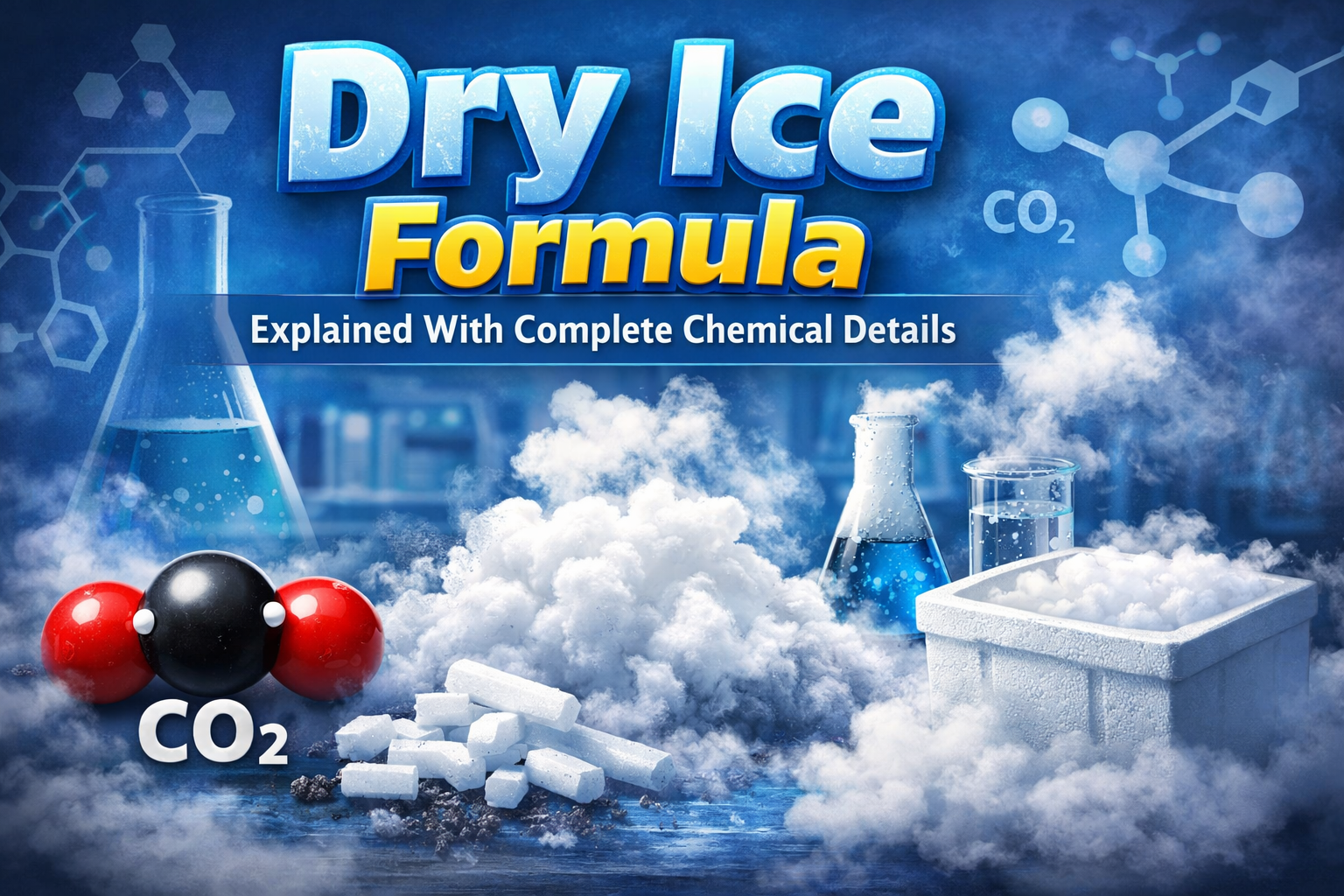
The dry ice formula is CO2. This formula shows that dry ice is made from carbon dioxide molecules. Carbon dioxide normally exists as a gas, but under special conditions, it transforms into a solid. The chemical composition does not change. Only the physical state changes, which is why dry ice remains carbon dioxide in every form.
Dry Ice Chemical Formula
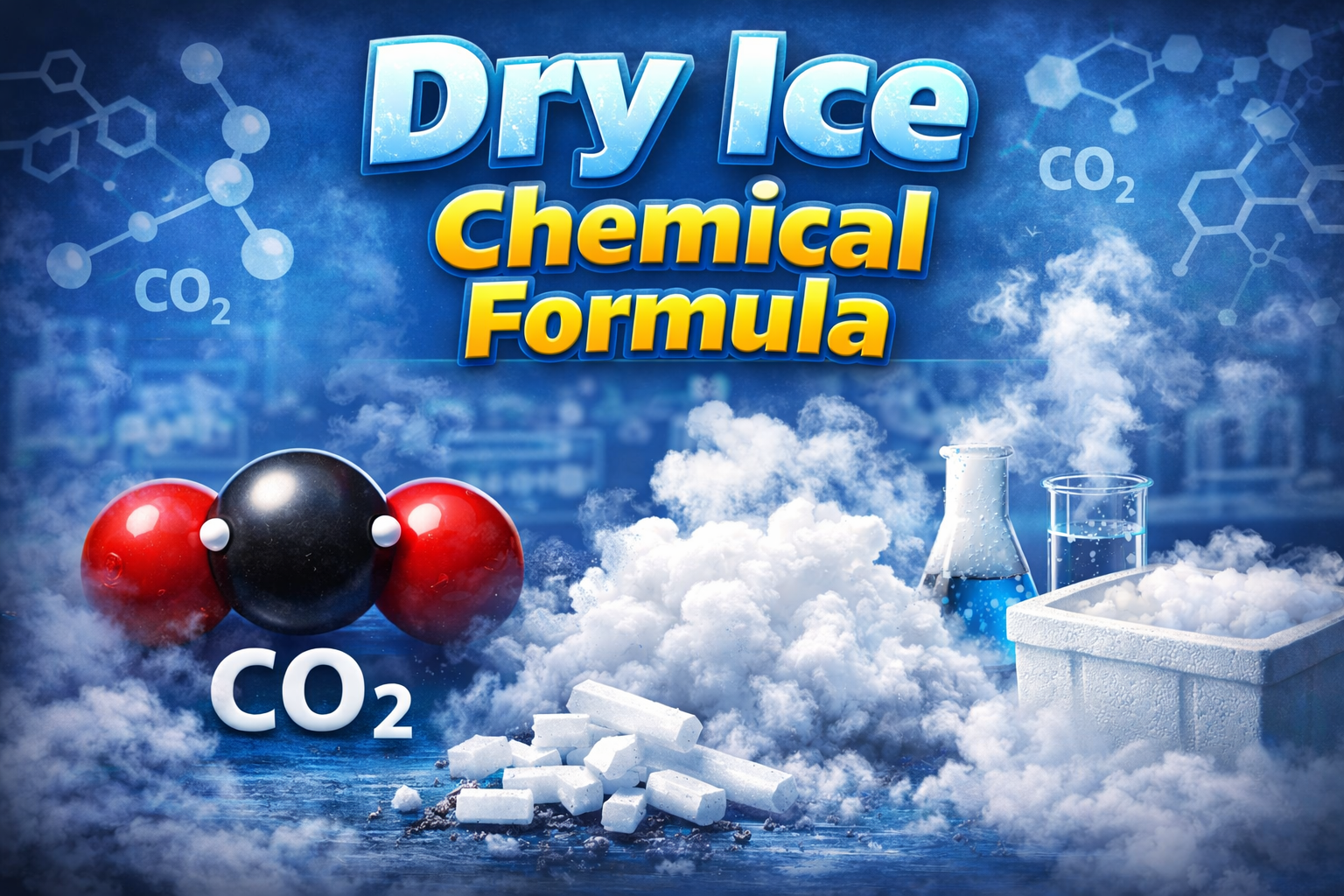
The dry ice chemical formula is CO2, which consists of one carbon atom and two oxygen atoms. These atoms stay bonded together whether carbon dioxide is in gas or solid form. This explains why dry ice is not a new compound but simply a solid version of carbon dioxide. The structure remains stable while the state of matter changes.
Why Dry Ice Does Not Melt
Dry ice does not melt like normal ice because it does not turn into liquid. Instead, it changes directly from solid into gas. This process happens due to its extremely low temperature. When exposed to room conditions, dry ice immediately begins converting into carbon dioxide gas without forming liquid.
Sublimation Process in Dry Ice
Sublimation is the process by which a substance changes from a solid to a gas without passing through the liquid stage. Dry ice is a perfect example of sublimation. As it absorbs heat from the surroundings, it releases carbon dioxide gas directly. This process is continuous and cannot be stopped at normal temperature.
Fog Effect Created by Dry Ice
The thick white fog produced by dry ice is often mistaken for smoke. In reality, it is not smoke. When cold carbon dioxide gas mixes with warm air, it cools the moisture present in the atmosphere. This moisture condenses into tiny water droplets that appear as fog. This effect is commonly used in events and stage performances.

Properties of Dry Ice
Dry ice has several unique properties that make it useful. It has an extremely low temperature, it sublimates instead of melting, it does not create water, and it expands quickly when converting into a gas. These characteristics make it powerful for cooling but also require careful handling.
Uses of Dry Ice
Dry ice is widely used in different industries. It helps preserve frozen food during transportation, maintains medical samples at safe temperatures, and supports laboratory research. It is also used in cleaning methods and visual effects. Because it leaves no moisture, it protects products from damage.
Role of Dry Ice in the Food Industry
In the food industry, dry ice is mainly used for shipping frozen items. It keeps products fresh for long durations and prevents bacterial growth. Since it does not melt into water, food packaging remains dry and clean throughout transportation.
Medical and Laboratory Importance
Dry ice plays a critical role in hospitals and laboratories. It is used to store vaccines, transport blood samples, and preserve sensitive biological materials. Accurate temperature control is essential in medical environments, and dry ice provides reliable cooling support.
Safety Measures While Using Dry Ice
Dry ice must always be handled with care. Direct contact with skin can cause cold burns. Protective gloves should be worn at all times. It should never be placed in sealed containers because pressure buildup can cause damage. Proper ventilation is necessary to prevent carbon dioxide accumulation.
Is Dry Ice Dangerous
Dry ice is safe when handled properly, but unsafe use can lead to serious risks. Exposure to high carbon dioxide concentrations can cause breathing difficulty. Improper storage may lead to container damage. Awareness and training help prevent accidents.
Difference Between Dry Ice and Normal Ice
Normal ice is frozen water, while dry ice is solid carbon dioxide. Normal ice melts into liquid water, whereas dry ice converts directly into gas. The temperature of dry ice is far lower than that of ordinary ice, which explains its stronger cooling ability.
Environmental Impact of Dry Ice
Dry ice is generally considered environmentally acceptable. The carbon dioxide used is usually recovered from industrial emissions. After use, it simply returns to the atmosphere without creating additional pollution.
Importance of Learning Dry Ice Formula
Learning the dry ice formula helps students build strong chemistry concepts. It improves clarity about physical changes and states of matter. This knowledge supports academic performance and practical awareness.
Common Misconceptions About Dry Ice
Many people believe dry ice is frozen water or toxic smoke. These are incorrect ideas. Dry ice is solid carbon dioxide, and its fog effect is simply condensed moisture. Correct information removes fear and improves safe usage.
Storage of Dry Ice
Dry ice should be stored in insulated containers that allow gas release. Even with proper storage, it slowly disappears over time due to sublimation. It should always be purchased close to the time of use.

FAQs:
Is dry ice safe in drinks?
Dry ice should not be placed directly in drinks because it can cause serious cold burns if swallowed. It is only safe when used for visual effect and completely removed before drinking.
Is dry ice unhealthy?
Dry ice is not unhealthy by itself, but breathing high amounts of carbon dioxide can be harmful. That is why it should always be used in open or well ventilated areas.
Why do doctors use dry ice?
Doctors use dry ice to keep medical samples, vaccines, and biological materials at very low temperatures during storage and transportation.
Is dry ice expensive?
Dry ice is usually affordable, but the price depends on quantity, location, and delivery distance. It is more costly for small orders.
Is dry ice used in hospitals?
Yes, dry ice is commonly used in hospitals to preserve medicines, vaccines, and laboratory samples that require controlled cold temperatures.
How long will dry ice last?
Dry ice usually lasts between eighteen and 24 hours in a well insulated container, depending on storage conditions and quantity.
What are the disadvantages of dry ice?
Dry ice can cause skin burns, cannot be stored long term, and may become dangerous in closed spaces due to gas buildup.
Does dry ice melt?
No, dry ice does not melt. It changes directly from solid into gas through sublimation.
Can dry ice be used in food?
Dry ice can be used for food transportation and cooling, but it must never touch food directly and should be kept properly.
Conclusion
The dry ice formula is CO2, which represents carbon dioxide in solid form. The dry ice chemical formula remains unchanged even when its physical state changes. Dry ice is extremely cold, highly effective, and widely used across food, medical, and industrial fields. With proper knowledge and safe handling, it becomes a valuable material with powerful applications.
Read More:
What is Dry Ice and Why It Matters in Saudi Arabia
What Is Dry Ice Used For in the Modern World of Industrial Gas and Advanced Cooling
Best Dry Ice Blasting Saudi Arabia: Eco Friendly and Efficient Cleaning Solutions
Dry Ice Dangers You Cannot Ignore: Hidden Health Risks and Safe Handling Truths